# Introduction
## **What is Lydian?**
Lydian is a *decentralised treasury management protocol* based on the **LDN** token on the Stacks Blockchain. Each **LDN** token is backed by multiple assets (e.g. USDA) in the Lydian treasury, giving it an intrinsic value. Lydian also brings to the table valuable economic and game theory dynamics in the market via [staking ](/staking-and-bonding/staking)and [bonding](/staking-and-bonding/bonding).

Lydian is inspired by the designs of the groundbreaking DeFi protocols that have seen success these last few years. Some of these inspirational protocols are Olympus, Wonderland and Keeper DAO.
**Active management of the treasury** by the DAO is a key aspect of Lydian, allowing participants to have high quality investments without having to micro-manage them.

For an in-depth explanation of how Lydian works, you can read these docs that are based on the documentation of [Olympus DAO](https://docs.olympusdao.finance/).
## **How do I participate in Lydian?**
There are two main strategies for market participants: [staking ](/staking-and-bonding/staking)and [bonding](/staking-and-bonding/bonding). Stakers stake their **LDN** tokens in return for more **LDN** tokens, while bonders provide tokens in exchange for discounted **LDN** tokens after a fixed vesting period.
Governance participants can get involved on our forum and through discussions on our [community discord](https://discord.gg/KwKStXZ26x). We are always looking for new community members to contribute!
## **How can I benefit from Lydian?**
The main benefit for stakers comes from supply growth. The protocol mints new **sLDN** tokens from the treasury, the majority of which are distributed to the stakers. Thus, the gain for stakers will come from their compounding balances.
As the Lydian Treasury farms yield, it is added to the treasury and used to fuel future rebases. Should the **LDN** token fall below the treasury-backed value then the treasury can be used to repurchase **LDN** tokens, guaranteeing a floor value for **LDN**.
## **What is the goal of Lydian?**
The goal of Lydian is to become a **Guild of Farmers** and explore strategies within the Stacks ecosystem. Lydian will deploy its treasury to farm yield on Stacks and distribute that to token holders. It will create added value through its size and sophistication.
## **Who is the team behind Lydian?**
Lydian is developed by a team of pseudonymous programmers and Stacks enthusiasts.
## **Who runs Lydian?**
No one. Lydian is DAO-governed. **All decisions are formed by community members (Guild)** on Discord and made by token holders through snapshot voting.
# Core Vision
Lydian is a community-driven DAO that features DeFi 2.0 mechanics at its core and resides on the Stacks Blockchain. The vision we have is for Lydian to be a fun and profitable project for both DeFi experts and for those new to DeFi. We want all members to benefit by staking 3.3 without needing to be concerned with the details of farming and having to stay updated on the latest news regarding protocols and features.
We want our members to feel confident that together, as a DAO, we are committed to being the best DeFi project out there. As such, Lydian will grow as the ecosystem grows. The treasury of Lydian will be put to use in various farming opportunities in the ecosystem, while also maintaining the TBV (Treasury Backed Value). **The key focus of the DAO is to actively manage our treasury for optimal sustainable growth.**

This will benefit the Lydian community by investing the income that flows into the treasury. It will also benefit the Stacks ecosystem because Lydian's treasury results in TVL and protocol revenue.
The community on Stacks will benefit from a central agora to gather and discuss the wider DeFi movement while profiting from treasury growth together.
# Active Treasury Management
The goal of Lydian is to accumulate a healthy mix of assets in its treasury. We want to own **USDA as a stable backing asset** for future rebases which makes up our RFV. We also want **LDN-UDSA LP tokens to ensure** that the Lydian token always has enough **liquidity** for users to enter and exit our guild.
One thing the Lydian governance process needs to converge on is the **balance between backing assets** used to extend the project runway for rebases **and the capital used to deploy in farming** strategies. This ratio will be an important parameter to manage.

DeFi on Stacks is still evolving and the amount of functional protocols is currently still quite limited. We've chosen Arkadiko as an initial protocol to partner with and to host our initial liquidity pool.
The main goal for the treasury is to generate returns on capital. We could do this by deploying capital in yield farms, incubating new protocols and helping them with initial liquidity or by providing Keeper services.
The Lydian token will function as a governance token and the governance process will ultimately decide which farming strategy is followed and the amount of capital deployed.
The Lydian team will continuously scan for opportunities and keep track of new protocol launches. After a risk assessment, governance discussion, proposal and vote, the new opportunity could be added as a new farming strategy.
# Initial Token Distribution
## **Initial Token Distribution**
First let’s dive right into the distribution of the initial token supply.
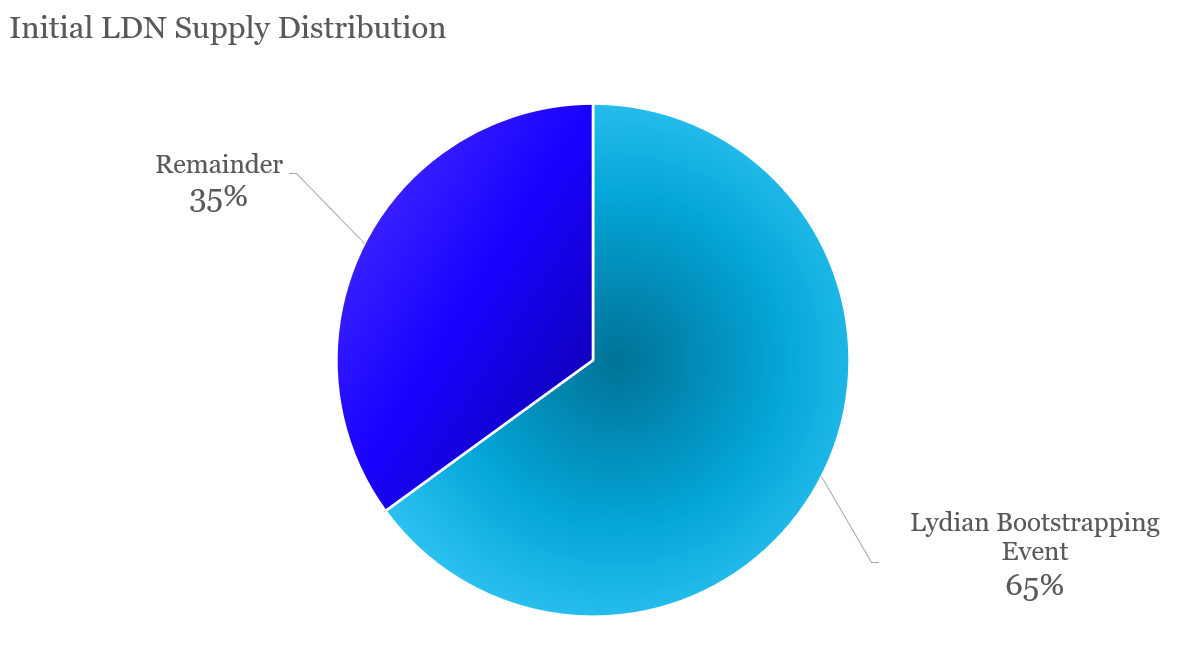
The **initial supply** will be 15 385 LDN, of which 10 000 LDN will be sold during the *Lydian kick-off Treasury Bootstrapping Event* (read more below).
In short:
65% of the initial supply will be up for sale during our Lydian kick-off Bootstrapping Event.
The remainder of the supply (35%) will be reserved for multiple purposes:
* 2,5% of this supply will account for the initial liquidity to jumpstart the protocol;
* 12,5% of this supply will be donated to the **Arkadiko DAO**;
* 20% will be reserved to cover the costs of development, maintenance and auditing of Lydian.
We’ve decided to allocate a chunk of the initial supply to the Arkadiko treasury for the following reasons:
1. Arkadiko is the leading DeFi protocol on Stacks and has a strong community that we want to attract;
2. We want to incentivise the Arkadiko DAO to accept LDN as a pair on the swap;
3. We expect the Arkadiko treasury to further distribute the LDN tokens to their community, creating an initial user base of DeFi users for Lydian.
# Launch information
## **Lydian Kick-off — Treasury Bootstrapping Event**
In an effort to ensure all earliest followers of Lydian get a premium experience, the DAO will organize a fair and transparant launch. The journey will kick off with the special two-day Treasury Bootstrapping Event (TBE). **The TBE will be in the format of a Dutch Auction**.
> *The LDN treasury bootstrapping event (TBE) will be held on the* [*Lydian website*](https://lydian.xyz/) *on March 15 2022 (starting time 15:00 CET) and will come to a close either after 4 days or when all tokens have been sold, whichever will happen first. When the auction closes, the tokens from this event will be claimable.*
A dutch auction will allow anyone to place a bid/commit on a portion of the initial token supply. The auction will end either when the total initial token supply has been committed, or after the predetermined auction runtime of 4 days.
In this auction, the price per token is set arbitrarily, slightly higher than the initially expected value. This will **dissuade the usage of bots** and interest of whales that would scoop up large portions of the initial token supply, resulting in future risks for Lydian.
The price per token will decline from the initial value as the auction time passes. Every commit action that takes place will result in a small bump in price per token.
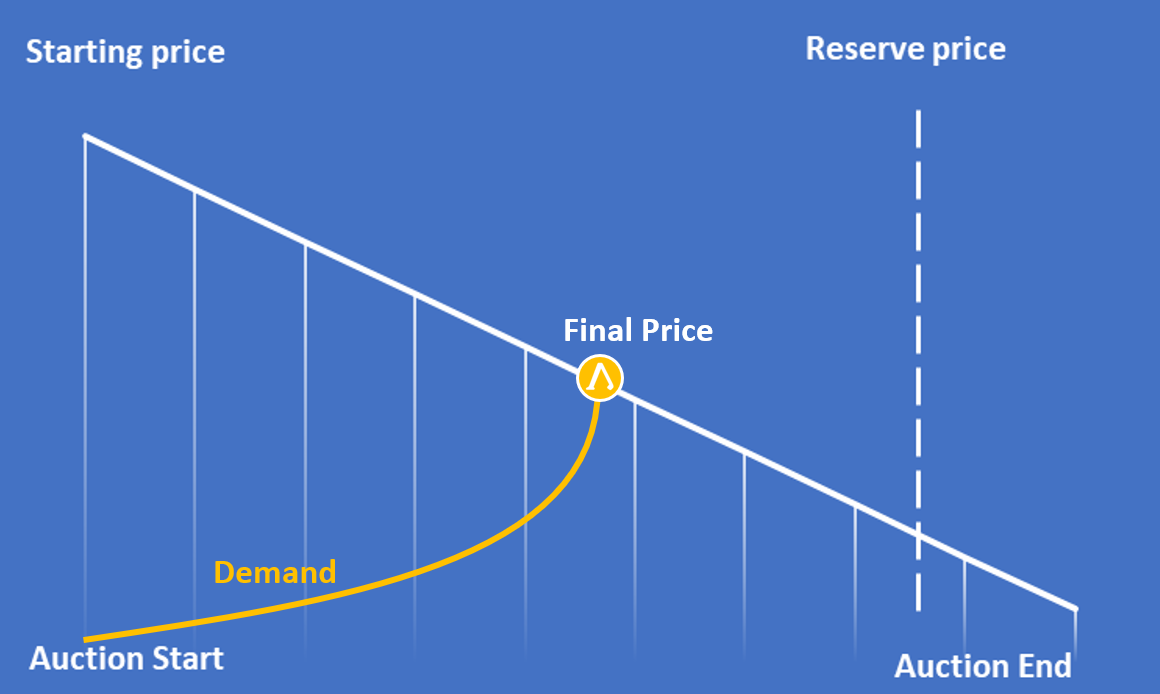
This mechanism allows for a **fair initial price discovery by the community**. Participants will individually choose at which token price point and how many tokens they are willing to buy and commit their funds. However, the final price per token will be determined at the end of the auction. This means that all participants who have committed their funds will pay the exact same price per token. **In other words, although you might have committed at a certain price point, all auction contributors will get the same minimally agreed price.**
The end of the auction occurs once all tokens are committed for purchase or after the predetermined auction runtime of 96 hours. Shortly after the auction concludes, the tokens will be claimable by those who have committed for a portion of the supply.
> This is the **first opportunity** for the general public **to mint LDN** and to participate in the governance of the network. All proceeds will go to the Lydian Treasury, a smart contract entirely controlled by LDN token holders.
We acknowledge the **risks** of this type of TBE compared to a more common initial bonding sale free-for-all. To elaborate; the chances of a token overvaluation during launch are limited, thus resulting in a more modest (and realistic) treasury. This is caused by:
1. bots and whales that are dissuaded from scooping up a large portion of the initial supply;
2. a longer period of time to buy, allowing more people to participate and generating less fear of missing out;
3. all tokens are sold and thus valuated at the lowest agreed price during the auction, causing a fair price discovery.
Nevertheless, we also acknowledge the major **benefits** for our community and protocol longevity, such as:
1. fair price discovery, equal for all participants,
2. no first come, first serve, there will be plenty of time to participate in the event and join the guild,
3. a greater distribution of tokens. More members means more stability and robustness for Lydian.
We have great respect for the Stacks community and DeFi enthusiasts in general. **At Lydian, we are therefore committed to continue placing the interests of the community first.** We believe this is the only way to ensure a long and healthy future for any project in the Crypto space.
In that same vein; there will be **no whitelist or privileged entries** for the Bootstrapping Event. **Anyone with USDA (Arkadiko) can take part in the dutch auction and use it to mint LDN.** Please make note that in order to mint LDN during the auction, some STX will be needed to cover the transaction’s gas fees.
## **What’s next? — Fuel your tractor and prepare to harvest some crops!**
Following the 4-day period of this kick-off event, we will seed liquidity for the LDN token using 3.75% of USDA raised in the treasury together with 385 LDN.
Staking for LDN will be added after TBE but before bonding. Our plan is to list a LDN-USDA pair on Arkadiko Swap pending governance approval. After the creation of the pool, participants of the dutch auction will be able to add liquidity and prepare themselves for the first bonding event which will take LDN-USDA LP as its bonding asset. This will create protocol owned liquidity for LDN-USDA, which is important for Lydian to incentivise.
1. **Treasury Bootstrapping Event:** Predetermined parameter launch focused on bootstrapping the treasury with USDA.
2. **LDN Staking Launch:** Earn yield through rebases.
3. **wLDN-USDA** **Bonding Programme:** Additional LDN tokens are created by the bonding mechanism which enables the protocol to own LDN-USDA LP tokens.
# How to: Bootstrapping Event

*This is the **first opportunity*** ***to mint LDN** and to participate in the governance of the network. All proceeds will go to the Lydian Treasury, a smart contract entirely controlled by LDN token holders.*
The LDN **Treasury Bootstrapping Event** (TBE) will commence on the Lydian dApp on March 15th 2022 (aiming for a block number around 15:00 CET (09:00 EST, 23:00 KST/JST)) and will come to a close either after a predetermined 4 days or when all tokens have been sold, whichever will happen first. Even if all tokens are sold, tokens will only be claimable after the 4th day.
## **1. Brief summary**
The concept of the Treasury Bootstrapping Event is an adaptation of a dutch auction with a **linearly dropping price point**. During the event commitments to purchase tokens can made in **USDA** (Arkadiko stablecoin).
In this auction, the starting price is set at an elevated price per token to minimise the interest of bots and whales. The price then drops as time passes. The eventual, final price will be decided once all tokens have been committed to for purchase. Participants will individually choose when (and thus at which price) they are willing to buy tokens and commit their funds — yet the auction continues until all tokens have been reserved. The eventual, final price of LDN will be decided at the end of the auction, in part based on if and how fast the token was able to sell out (full supply committed).
This could potentially lead to a lower total amount raised for the treasury. However**, all participants will get their tokens at an equal price, being the lowest price point the auction reached**.

## **2. Engaging in the Token Bootstrapping Event**
There will be no whitelist or privileged entries for the Bootstrapping Event. Anyone with **USDA** (Arkadiko stablecoin) can take part in the dutch auction and use it to mint LDN. Please make note that in order to mint, some STX will be needed to cover the transaction’s gas fees.
Below you will find a step by step guide on how to take part in the bootstrapping event:
1. Visit the **Lydian** website ([lydian.xyz](https://www.lydian.xyz/)).\
**Note**: It’s important to always go directly to the site to avoid any phishing hyperlinks or use a validated browser bookmark.
2. Enter the dApp.
3. Click the “**Connect Wallet**” button in the top right corner.
4. Ensure that your wallet is connected to the Stacks Network by clicking in the top left corner of your wallet.
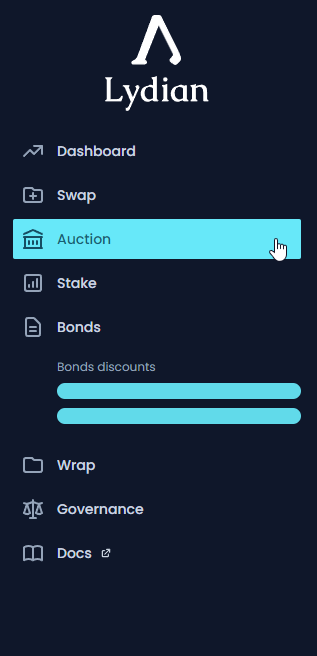
5. In the navigation bar, select “**Auction**”.
6. Here you will be presented with some more information on the current status of the event and information about the bonding commitment and a countdown timer will be displayed.
Go to the “**Commit**” tab
1. On the **Commit page** you can place your bid. You can use the input box to enter the amount of USDA you want to commit.\
The amount of LDN you would get for your USDA is then calculated based on the current auction LDN token price and subsequently recorded and reserved.\
**Note**: If there are less LDN tokens of the initially supply still available than the amount you want to reserve, your reservation will be capped to the amount that is still available.

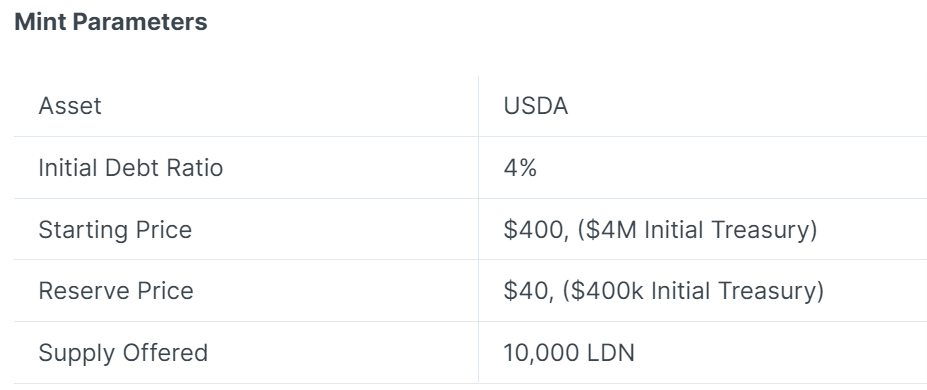
During the auction, the price of the token will start at 400,00 USDA and will slowly drop to a reserve price of 40,00 USDA per LDN token. The eventual and final token price of the auction will be decided, based on when the auction ends. Each participant will be able to get their recorded LDN amount at the exact same price.
**IMPORTANT**: You need to approve the transaction in your wallet.
1. After approving your transaction, you should see a pop-up on the app saying your tokens have been sent with a link to Stacks Explorer.
2. Once your wallet confirms that the transaction has been completed, your tokens will be formally committed.
**Note**: Your tokens will be held securely by the auction contract until the auction ends. Please return when the event ends to claim your tokens.
## **3. Claiming your tokens after the event**
When the maximum runtime of the event concludes on March 19 2022, you will be able to claim your tokens. Even if all tokens are sold causing an earlier end, tokens will only be claimable after the 4th day. This is how to do it:
1. Return to the **Lydian** website ([lydian.xyz](https://www.lydian.xyz/)).\
**Note**: It’s important to always go directly to the site to avoid any phishing hyperlinks.
2. Enter the dApp.
3. Click the “**Connect Wallet**” button in the top right corner.
4. Ensure that your wallet is connected to the Stacks Network by clicking in the top left corner of your wallet.
5. In the navigation bar, select “**Auction**”.
6. Go to the “**Claim**” tab to claim your LDN
7. Your wallet will ask if you wish to allow **Lydian** to spend and withdraw your asset. Review the details carefully and confirm.
8. You should see a pop-up on the app saying your tokens have been sent with a link to Stacks Explorer.
9. After they arrive in your wallet, the you should see your LDN amount displayed in your wallet and in the token overview at the top of the dApp. (hard refresh the page with CTRL+F5 if it is not displaying correctly )
## 4. Conclusion
Lydian’s primary focus is to optimize Yield Farming for its guild members. Using the treasury we build during this kick-off event, Lydian will be able to **procure the best yields on the market for its members**.
We hope you are able to **grab your LDN** and **claim your membership** of the Farmers Guild.
If you want to know what’s next after this TBE, please refer to [our previous article](https://link.medium.com/SrXIRqc75nb).
# Simplified example
This type of launch event can seem complicated. That is why we have included a simplified example to explain some of the concepts of the dutch auction.
Any questions regarding this launch event can be posted to [Twitter ](https://twitter.com/Lydian_DAO)or [Discord](https://discord.gg/UFg6U4cPcc).
### Example
In our example, the auction has only 4 participants. Each participant wants to commit their USDA to get LDN in return.
| Starting Price | Reserve Price | Token Supply |
| -------------- | ------------- | ------------ |
| 400 USDA | 40 USDA | 10,000 LDN |

**Commit**
The auction starts and Participant 1 commits 20,000 USDA straight away. This means he is the first to affect the LDN token price. During the auction the token price will be determined with the following formula:
$$
TokenPrice = \dfrac{TotalUSDACommitted}{TokenSupply}
$$
The auction continues and after a period of time Participant 2 wants to commit his 150,000 USDA. Since the auction has been going for some time, the Auction Price has lowered to 350 USDA. Participant 2 has bumped the Token Price to 17 USDA, since there is now a total of 170,000 USDA committed in the auction.
In our example the 4th Participant commits $600,000, pushing the total USDA commited to 1,000,000 USDA and in turn pushing the total Token Price to 100 USDA. Since the auction had run for some time, the Auction Price had already dropped to that point.
If the Token Price equals the Auction Price, the auction ends, since all tokens have been sold at that point.
In other words, as long as the Token Price is lower than the Auction Price, the Auction Price will continue to drop until it meets the Token Price or until it meets the Reserve Price of 40 USDA.
Since all tokens in our example have now been reserved, the auction ends early. This sets the final LDN token price at 100 USDA. Since the auction ended at t2 (see graph below), the reserve price of 40 USDA becomes obsolete.

**Claim**
After the predetermined runtime of the auction of 4 days, all participants will be able to claim the respective, percentage of LDN at the price of 100 USDA compared to the equation of USDA they've committed vs. the total amount of USDA in the auction.
$$
Claimable LDN = \dfrac{CommittedUSDA}{TotalCommittedUSDA} . TokenSupply
$$
— Participant 1 gets to claim **200** LDN for 20,000 USDA.
— Participant 2 gets to claim **1500** LDN for 150,000 USDA.
— Participant 3 gets to claim **2300** LDN for 230,000 USDA.
— Participant 4 gets to claim **6000** LDN for 600,000 USDA.

# LDN
**LDN is the base governance token of the Lydian protocol.** It represents a share of the total Treasury and is your Guild Membership card.
Your weight in governance votes is also determined by the amount of Lydian tokens you have in your wallet, whether its LDN, sLDN or wLDN.
We strongly advise to always have your LDN in the form of **sLDN** or **wLDN**. This way the tokens will accrue rebase rewards, which regular LDN will not.
In the end, it is up to you which part of your LDN you want to stake and which part you want to provide as liquidity to the protocol.
As always, the [Lydian Discord](https://discord.gg/UFg6U4cPcc) is a great place for an open discussion with other Guild Members, who are faced with the same conundrums to get the best rewards.
# sLDN (staked LDN)
### sLDN characteristics
Staking allows you to earn more LDN passively via compounding rebase rewards.
By staking your LDN with Lydian, you receive sLDN(staked LDN) in return at a 1:1 ratio. After you receive your sLDN, your can claim your sLDN rewards that have been growing based on their respective APY.
On every rebase (3x/day) you get rewards based on the amount in your wallet + the rewards you still need to claim.
The original amount of sLDN that you have staked can be sent or wrapped at any time. However, before you can send or wrap sLDN rebase rewards you have earned, you will first need to claim those rewards. (those rewards have been accruing their own rewards as well).
# wLDN (wrapped LDN)
### wLDN characteristics
Wrapping of LDN enables the sLDN token to be used on other protocols and in the future might even go off-chain.
Both sLDN and wLDN will generate rebase rewards.
The benefit of holding wLDN over sLDN is that you do not need to manually claim your rebase rewards, instead the value of your wLDN will automatically increase.
wLDN is a representation of a separate sLDN pool. The sLDN pool grows because of rebase rewards and the index will increase to track the ratio of wLDN over sLDN in the pool.
### wLDN for bonding \[deprecated]
#### To participate in the first bonding event of Lydian:
Trade your wLDN and USDA (pair) for wLDN-USDA LP tokens on Arkadiko to participate in the first bonding event on Lydian.
When bonding, additional sLDN tokens are created by the bonding mechanism which enables the protocol to own wLDN-USDA LP tokens.
*In the future, decisions will be made on which other tokens should be accepted for bonds and thus become part of Lydian’s treasury.*
Likely token candidates for LP for the next Bonds will enable Lydian to start expanding and deploying its Yield Farming Strategies further across the ecosystem.
# FAQ
## Why do we need Lydian in the first place?
Like some pioneering DeFi protocols before us, Lydian wants to launch a free-floating reserve currency (LDN) backed by a variety of assets. By focusing on supply growth rather than price appreciation, Lydian hopes that LDN can function as a currency capable of maintaining its purchasing power regardless of market volatility.
Unlike most stablecoins, the impact of price depreciation of the US dollar will be significantly less for LDN, since its value is backed by a variety of assets.
Lydian will grow as the ecosystem grows. Lydian's treasury should be used in various farming opportunities in the ecosystem, while also maintaining the RFV. This will benefit the Lydian community by investing the income that flows into the treasury. It will also benefit the Stacks ecosystem because Lydian's treasury results in TVL and protocol revenue.
## Is LDN a stable coin?
No, LDN is not a stablecoin. Rather, LDN represents a share in the Lydian DAO and underlying treasury. As the treasury grows, your share becomes more valuable. You'll also be earning rebase rewards through the underlying mechanism of protocol owned liquidity.
## LDN is backed, not pegged.
Each LDN is backed by the assets in the treasury. Because the treasury backs every LDN, the protocol would buy back and burn LDN when it trades below the treasury backed value. This has the effect of pushing LDN price back up to the treasury backed value.
You might say that the LDN floor price or intrinsic value is equal to the treasury value. We believe that the actual price will always be above the treasury value, but in the end that is up to the market to decide.
## How does it work?
At a high level, Lydian consists of its protocol managed treasury, protocol owned liquidity (POL), bond mechanism, and staking rewards that are designed to control supply expansion.
Bond sales generate profit for the protocol, and the treasury uses the profit to mint LDN and distribute them to stakers. With liquidity bonds, the protocol is able to accumulate its own liquidity. Check out the entry below on the importance of POL.
## What is the deal with (3,3) and (1,1)?
(3,3) is the idea that, if everyone cooperated in Lydian, it would generate the greatest gain for everyone (from a [game theory](https://en.wikipedia.org/wiki/Game_theory) standpoint). Currently, there are three actions a user can take:
* Staking (+2)
* Bonding (+1)
* Selling (-2)
Staking and bonding are considered beneficial to the protocol, while selling is considered detrimental. Staking and selling will also cause a price move, while bonding does not (we consider buying LDN from the market as a prerequisite of staking, thus causing a price move). If both actions are beneficial, the actor who moves price also gets half of the benefit (+1). If both actions are contradictory, the bad actor who moves price gets half of the benefit (+1), while the good actor who moves price gets half of the downside (-1). If both actions are detrimental, which implies both actors are selling, they both get half of the downside (-1).
Thus, given two actors, all scenarios of what they could do and the effect on the protocol are shown here:
* If we both stake (3, 3), it is the best thing for both of us and the protocol (3 + 3 = 6).
* If one of us stakes and the other one bonds, it is also great because staking takes LDN off the market and put it into the protocol, while bonding provides liquidity and USDA for the treasury (3 + 1 = 4).
* When one of us sells, it diminishes effort of the other one who stakes or bonds (1 - 1 = 0).
* When we both sell, it creates the worst outcome for both of us and the protocol (-3 - 3 = -6).
## Why is TBV (Treasury Backed Value) important?
As the protocol controls the funds in its treasury, LDN can only be minted or burned by the protocol. This also guarantees that the protocol can always back 1 LDN with treasury assets. You can easily define the risk of your investment because you can be confident that the protocol will indefinitely buy LDN below the treasury value with the treasury assets until no one is left to sell. You can't trust the FED but you can trust the code.
As the protocol accumulates more TBV, more runway is guaranteed for the stakers. This means the stakers can be confident that the current staking APY can be sustained for a longer term because more funds are available in the treasury.
## Why is POL important?
Lydian owns most of its liquidity thanks to its bond mechanism. This has several benefits:
* Lydian does not have to pay out high farming rewards to incentivize liquidity
providers a.k.a renting liquidity.
* Lydian guarantees the market that the liquidity is always there to facilitate
sell or buy transaction.
* By being the largest LP (liquidity provider), it earns most of the LP fees which
represents another source of income to the treasury.
* All POL can be used to back LDN. The LP tokens are marked down to their risk-free
value for this purpose. You can read more about the rationale behind this in this
[Medium article](https://olympusdao.medium.com/dai-bonds-a-more-effective-sales-mechanism-c9a57586f1f7).
## Why is the market price of LDN so volatile?
It is extremely important to understand how early in development the Lydian protocol is. A large amount of discussion has centered around the current price and expected a stable value moving forward. The reality is that these characteristics are not yet determined. The network is currently tuned for expansion of LDN supply, which when paired with the staking, bonding, and yield mechanics of Lydian, result in a fair amount of volatility.
LDN could trade at a very high price because the market is ready to pay a hefty premium to capture a percentage of the current market capitalization. However, the price of LDN could also drop to a large degree if the market sentiment turns bearish. We would expect significant price volatility during our growth phase so please **do your own research** whether this project suits your goals.
## What is a rebase?
Rebase is a mechanism by which your staked LDN balance increases automatically. When new LDN are minted by the protocol, a large portion of it goes to the stakers. Because stakers only see staked LDN balance instead of LDN, the protocol utilizes the rebase mechanism to increase the staked LDN balance so that 1 staked LDN is always redeemable for 1 LDN.
## What is reward yield?
Reward yield is the percentage by which your staked LDN balance increases on the next epoch. It is also known as *rebase rate*. You can find this number on the Lydian staking page.
## What is APY?
APY stands for annual percentage yield. It measures the real rate of return on your principal by taking into account the effect of compounding interest. In the case of Lydian, your staked LDN represents your principal, and the compound interest is added periodically on every epoch thanks to the rebase mechanism.
One interesting fact about APY is that your balance will grow not linearly but exponentially over time! Assuming a daily compound interest of 2%, if you start with a balance of 1 LDN on day 1, after a year, your balance will grow to about 1377. That is a lot!

## How is the APY calculated?
The APY is calculated from the reward yield (a.k.a rebase rate) using the following equation:
$$
APY = ( 1 + rewardYield )^{1095}
$$
It raises to the power of 1095 because a rebase happens 3 times daily. Consider there are 365 days in a year, this would give a rebase frequency of 365 \* 3 = 1095.
Reward yield is determined by the following equation:
$$
rewardYield = LDN\_{distributed} / LDN\_{totalStaked}
$$
The number of LDN distributed to the staking contract is calculated from LDN total supply using the following equation:
$$
LDN\_{distributed} = LDN\_{totalSupply} \times rewardRate
$$
Note that the reward rate is subject to change by the protocol. For example, it has been revised due to this latest proposal.
## How does the protocol manage to maintain the high staking APY?
Let’s say the protocol targets an APY range of 1,000% to 10,000%, this would translate to a *minimum* reward yield of about 0.2105%, or a daily growth of about 0.6328%. Please refer to the equation above to learn [how APY is calculated from the reward yield](#how-is-the-apy-calculated).
If there are 10,000 of LDN staked right now, the protocol would need to mint an additional 63.28 LDN to achieve this daily growth. This is achievable if the protocol can bring in at least $63.28 of daily revenue from bond sales or yield farming. Even if the protocol doesn't bring in that much revenue, it can still sustain 1,000% APY for a considerable amount of time (see the runway chart for instance) due to the excess reserve in the treasury.
## Do I have to unstake and stake LDN on every epoch to get my rebase rewards?
No. Once you have staked LDN with Lydian, your staked LDN balance will auto-compound on every epoch. That increase in balance represents your rebase rewards.
# Staking
## What is Staking
**Staking is the primary value accrual strategy of Lydian.** Stakers stake their LDN on the Lydian website to earn rebase rewards. The rebase rewards come from the treasury proceeds from bond sales, and can vary based on the number of LDN staked in the protocol and the reward rate set by the monetary policy.

**Staking is a passive, long-term strategy.** The increase in your stake of LDN translates into a constantly falling cost basis converging on zero. This means even if the market price of LDN drops below your initial purchase price, given a long enough staking period, the increase in your staked LDN balance should eventually outpace the fall in price.
**When you stake, you lock LDN and receive an equal amount of sLDN.** Your sLDN balance accrues rebase rewards automatically in the form of sLDN at the end of every epoch (3x/day), however, you will need to claim the rewards to add them to your balance. If the rewards are not claimed right away, there is not inefficiency, as they have been accruing their own rewards just fine.
Before you can send or wrap your sLDN you will need to claim all rewards first so your balance is updated.
**When you unstake, you burn sLDN and receive an equal amount of LDN.** Unstaking means the user will forfeit the upcoming rebase reward. Note that the forfeited reward is only applicable to the unstaked amount; the remaining staked LDN (if any) will continue to receive rebase rewards.

# How to: Stake
* Go to the Lydian dApp. [www.lydian.xyz](https://docs.lydian.xyz/staking-and-bonding/staking/www.lydian.xyz)
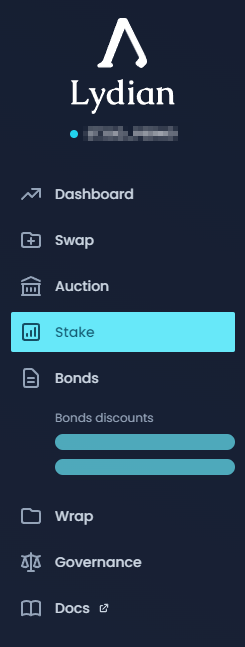
* Select the “Stake” tab in the Navigation menu.
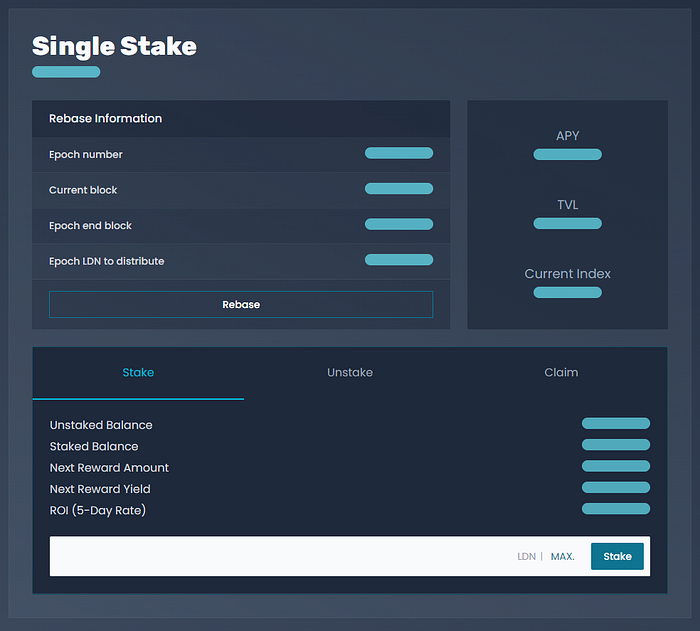
* Enter the amount of LDN that you would like to stake in the input field. If you would like to stake all your LDN, press the “MAX” button and the input field will be populated with your total available LDN balance.
* Click “Stake” and sign the transaction.
* After you “Confirm” transaction has been processed and signed successfully you have staked your LDN!
# Bonding
## What is bonding?
**Bonds give you the opportunity to receive sLDN from the protocol at a discount.**
1. **You pay for the sLDN with liquidity.** This helps the protocol accumulate liquidity shares. Instead of using USDA to bond, you use wLDN-USDA LP (first bonds) or other accepted assets in the future. But it is in fact the same as any regular trade; you give the protocol an asset (token or LP), and in return you get another asset (sLDN).
2. **The demand for bonds dictates the discount you get.** The market is still relevant because the LP share or token you provde in exchange for the bonds gets more or less valuable, but it’s not what actually drives what you get. Instead, the bond discount goes up when there are more bonds, and goes down when there are less bonds.
3. **Your committed LP or token is locked once you bond.** This is important to note. When you make the trade, you have made the trade. Think of it as exchanging your token or LP token in exchange for sLDN.
**Bonding is the secondary value accrual strategy of Lydian.** It allows Lydian to acquire its own liquidity and other reserve assets such as USDA by selling sLDN at a discount in exchange for these assets. The protocol quotes the bonder with terms such as the bond price, the amount of sLDN tokens entitled to the bonder, and the vesting term. The bonder can claim some of the rewards (sLDN tokens) as they vest, and at the end of the vesting term, the full amount will be claimable.

**Bonding is an active, short-term strategy.** The price discovery mechanism of the secondary bond market renders bond discounts more or less unpredictable. Therefore bonding is considered a more active investment strategy that has to be monitored frequently in order to be more profitable as compared to staking.
**Bonding allows Lydian to accumulate its own liquidity.** We call our own liquidity POL. More POL ensures there is always locked exit liquidity in our trading pools to facilitate market operations and protect token holders. Since Lydian becomes its own market, on top of additional certainty for LDN investors, the protocol accrues more and more revenue from LP rewards bolstering our treasury.
# Example: Participate in the first Bond Offering
### 1A. When starting from the Auction
* On the Lydian dApp ([www.lydian.xyz](https://app.lydian.xyz/)) claim your tokens as **wLDN** or if you have claim them as LDN, use the "Wrap" function on the Lydian dApp to convert your LDN to **wLDN.**
### **1B. When starting from the Arkadiko airdropped tokens**
* After you have claimed your tokens here: \
no token transformation is needed, since you have claimed **wLDN**.
### 2. Getting the LP token
* Find the correct pool on **Arkadiko Swap**: \
* Add the tokens (**wLDN** and **USDA**) with equal value to the pool, corresponding to for how much you would like to participate in the Bond Offering.\
The current value of wLDN is 83.280217 USDA. Meaning for each wLDN, you'll need an equal value of USDA to add to the pool. In exchange you will receive an **LP token**.
### 3. Participating in the Bond Offering
* On the Lydian dApp ([www.lydian.xyz](https://app.lydian.xyz/)), navigate to Bonds from the menu. Available starting Tuesday, 22nd of March, 2 pm CET, 9 am EST, 10 pm KST/JST, for a maximum of 5 days.
* Put in the amount of LP tokens you would like to Deposit. In exchange for your LP token, you will receive an amount of sLDN.
* The amount of sLDN you will receive is based on the value of your LP token. Let's take a look at an example:\
\
1 wLDN = 83.28 USD\
\
You decide to get participate in the Bond Offering with 100 of your wLDN. \
\
You pair the 100 wLDN with 8,328 USDA (100x83.28 USDA), since both tokens need to be 50/50 in the pool. The LP tokens you will get in exchange have a total value of 16,656 USDA (2x100x83.28 USDA).\
\
The Bond offered on Lydian offers a max. of 14% discount \
\
The discount of 14% means you will receive 14% more sLDN than the value of your LP tokens. In numbers:\
The total value of your LP tokens was 16,656 USDA. When deposited in the Bond Offering at 14% discount, this means you will receive:
$$
sLDN = \dfrac{Value ;of; LP}{ (Value ;per; wLDN; token) (100%-discount%)}
$$
$$
232.5581 ;sLDN = \dfrac{16,656 ;USDA} {(83.28 ;USDA;; 0.86)}
$$
* Without the Bond Offering discount, the amount of sLDN tokens received would be:
$$
200 ;sLDN = \dfrac{16,656 ;USDA} {83.28 ;USDA}
$$
* Meaning you will have received 32.5581 sLDN tokens more than the value of your LP token.

# FAQ: First Bond Offering
:question: Where can I find information about the first bonds?
> :a: In the docs: and in the announcement article:
:question: Where can I find the liquidity pool to get the right LP token (wLDN-USDA)?
> :a: You can find the correct pool on Arkadiko Swap.
:question: When will the liquidity pool become available?
> :a: Arkadiko creation of liquidity pool (wLDN-USDA): Monday, 21st of March, 12 pm (noon) CET, 7 am EST, 8 pm KST/JST
:question: When will the first bonds open at Lydian?
> :a: Opening of the first bonds for LP: Tuesday, 22nd of March, 2 pm CET, 9 am EST, 10 pm KST/JST
:question: Do I claim my tokens as wLDN or LDN after the auction?
> :a: Both are fine now. wLDN is a wrapped representation of sLDN that allows you to use the token on other platforms (such as Arkadiko to get the LP token). wLDN will currently not grant rebase rewards since they are currently disabled until the staking feature is enabled.
:question: Should I ever hold base LDN in the future?
> :a: No, you should always have wLDN or sLDN, since this will grant you with rebase rewards once the staking feature is enabled and rebase rewards have been activated.
:question: When can I trade my LDN for wLDN?
> :a: The functionality to wrap and unwrap your LDN has been enabled:
:question: What are the bonding parameters for the initial bonds?
> :a: You can find them in the announcement article:
:question: There is a 770 LDN limit per bond, but if I want to value 1,000 LDN, is it possible to divide the bond into two (770 and 230)?
> :a: Yes, the limit per bond is 770 LDN, but you can make multiple transactions.
:question: When will staking of LDN be enabled?
> :a: When bond limit is reached, or after 5 days on Sunday, 27th of March (whichever comes first)
:question: When will swapping of LDN in the pool on Arkadiko Swap be enabled?
> :a: When bond limit is reached, or after 5 days on Sunday, 27th of March (whichever comes first)
# How to: Bond
* Go to the Lydian dApp [www.lydian.xyz](https://docs.lydian.xyz/staking-and-bonding/bonding/www.lydian.xyz)
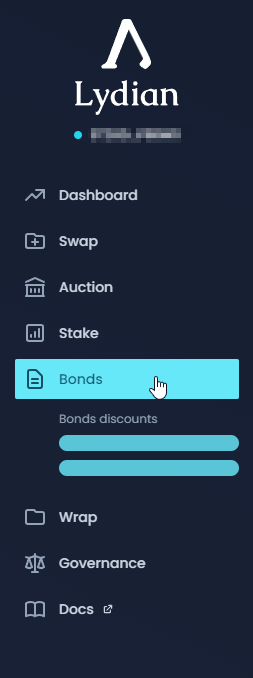
* Select the “Bonds” tab in the Navigation menu.
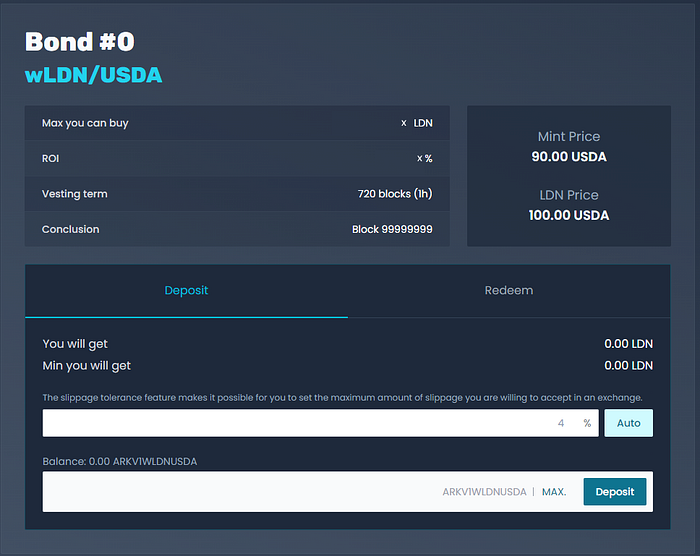
* Enter the amount of tokens or LP tokens that you would like to bond in the input field and determine your slippage. Review how much sLDN tokens you will get in return. Based on the current ROI (discount or premium) on the actual LDN price.
# Example: Rebase rewards
This example contains arbitrary numbers and is made for education purposes only.
### Both your sLDN and wLDN will earn rebase rewards. How does this work?
#### *Staking*
Let's assume you have 500 LDN and stake it for 500 sLDN. In total 5000 LDN is staked. The next rebase distributes 50 sLDN.
You have 10% of all sLDN, so you will get 5 sLDN as rewards. These rewards need to be claimed manually. Rewards not claimed do still receive rewards on next rebase.
#### *Wrapping*
Let's assume you have 500 LDN and the index is currently 1.25. In total 5000 LDN is wrapped so there is 4000 wLDN.
You wrap 500 LDN to 400 wLDN. Now a rebase happens which distributes 50 sLDN.
The 4000 wLDN is now representing the initial 5000 sLDN plus the 50 sLDN as rewards. So the index increases to 1.2625. You still have 400 wLDN in your wallet, but these now represent more sLDN.
# Links
## Official
* [Website](https://lydian.xyz)
* [Twitter](https://twitter.com/Lydian_DAO)
* [Medium](https://medium.com/@tribunusgracchus)
* [Discord](https://discord.gg/s84hm7nfqM)
* Forum